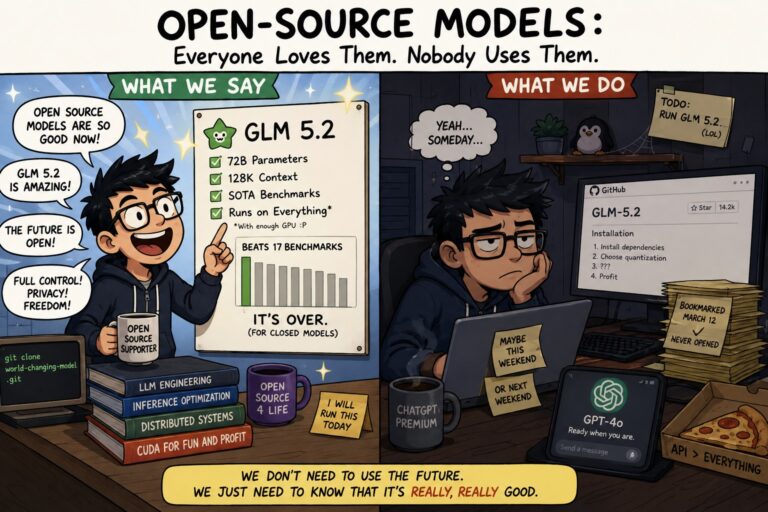
# The Shiny Object Trap: Using AI Without Losing Your Mind
A new piece of software just landed on your desk. Everyone in the office is talking about it. They say it can write your emails, schedule your meetings, and maybe even predict when you'll run out of coffee. It looks amazing. It feels like magic.
But then, Monday morning rolls around.
Instead of actually running your business, you spend three hours trying to figure out if the AI tool is actually better than the manual way you've used for five years. You're not working. You're playing with a new toy.
This is the big problem with Artificial Intelligence right now. There is a massive difference between a tool that helps you work and a tool that becomes your new full-time job.
The Difference Between Help and Hype
In a small business or a busy office, every minute counts. You have deliveries to track, clients to call, and spreadsheets that refuse to behave. You need tools that quietly sit in the background and make things easier.
A good tool is like a hammer. You pick it up, hit the nail, and put it back. You don't sit around admiring the hammer's sleek design or wondering if the hammer could also write a poem.
AI often feels more like a talking pet. It's fun to interact with. It's impressive when it does something clever. But if you spend more time "prompting" the machine than you do talking to your actual customers, you aren't using AI. You're being distracted by it.
We have to ask: Is this solving a real problem, or is it just a cool way to spend an afternoon?
Where the Value Actually Lives
If we strip away the excitement, AI is basically just a very fast pattern-matcher. It's great at things that involve repetitive logic or massive amounts of text.
For example, imagine you have a mountain of customer feedback. Instead of reading every single comment, an AI could group them into "happy, " "unhappy, " or "confused. " That is real utility. It saves you hours of boring work.
Or, think about data entry. If you have digital receipts that need to be sorted into a system, an AI can often do that much faster than a human can type. It's a quiet, boring, but incredibly helpful task.
The real value is in the "unseen"
The Danger of the "Black Box"
There is another trap: trusting the machine too much.
When we use a calculator, we know it's doing math. If it says 2+2=5, we know something is broken. But AI is different. It doesn't just give an answer; it gives an answer that sounds incredibly confident.
This is what experts call "hallucination. " The AI might tell you a fact that is completely made up, but it will say it with such grace and politeness that you might believe it.
If you use AI to write a report and you don't check the facts, you aren't being efficient. You're being risky. In a business, being fast is good, but being wrong is very expensive.
Efficiency without accuracy is just a faster way to make mistakes.
Staying Grounded in Your Workflow
So, how do you actually use this stuff without letting it take over your life?
First, define the pain point. Don't ask, "How can I use AI? " Ask, "What is the most annoying, repetitive task I do every single day? " If the AI can't fix that specific thing, don't buy it.
Second, keep a human in the loop. Think of AI as an intern. An intern can draft an email or organize a list, but you wouldn't let an intern sign a legal contract or promise a client a huge discount without your permission. You supervise the work. You provide the soul and the final check.
Third, ignore the noise. Every week, there is a new "revolutionary" tool. Most of them will be gone in six months. Stick to the basics. If a tool makes your workflow smoother without requiring a manual the size of a dictionary, then it might be worth your time.
The Human Element
At the end of the day, business is still a human endeavor.
Money changes hands between people. Promises are made between people. Problems are solved by people.
AI can help us organize the chaos, but it cannot replace the judgment that comes from years of seeing how things actually work in the real world. It can mimic intelligence, but it cannot mimic experience.
Use the technology to clear the clutter. But don't let the clutter become the main event. The goal isn't to have the smartest office; it's to have the most effective one.
Keep your eyes on the work, not just the screen.