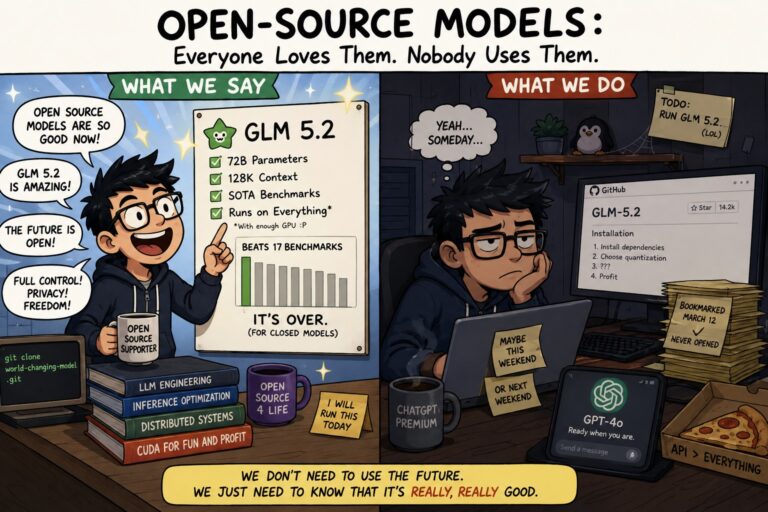
The Tool Trap: Why Having Everything Does Not Mean You Are Doing Everything
Most small business owners start with a simple dream. They want to sell a product, help a client, or build a service. They usually begin with a notebook, a laptop, and a decent internet connection.
But then, something strange happens.
First, they find a great app for managing tasks. Then, they realize they need a separate tool for emails. Suddenly, they are looking for a specialized program to track time, another to manage social media, and a third just to organize their digital files.
Before they know it, they aren't running a business anymore. They are running a collection of software.
It is a bit like trying to build a house, but instead of focusing on the bricks and the wood, you spend all your time trying to find the perfect, most high-tech hammer, the smartest measuring tape, and a laser-guided screwdriver. You end up with a garage full of shiny gadgets and no actual house.
The Modern Software Jungle
We live in an era where there is an app for every tiny human impulse. Want to track how many steps you take? There is an app. Want to know exactly how much water you drank? There is an app for that, too.
For a small business, this is a massive temptation. We are told that more automation equals more freedom. We are told that if we just find the right "all-in-one" system, the chaos will disappear.
But here is what the salespeople don't mention: every new tool comes with a hidden tax.
That tax isn't always money. Sometimes, it is time. It is the time you spend watching tutorials to learn how the dashboard works. It is the hour you spend trying to make Tool A talk to Tool B because they refuse to share data. It is the mental energy required to remember ten different passwords and fifteen different interfaces.
Complexity is a quiet killer. It doesn't crash your system with a loud bang; it just slowly eats your afternoon, one "setup" notification at a time.
The Illusion of Productivity
There is a very specific kind of feeling that comes with setting up a new productivity system. You move some digital cards around. You color-code your calendar. You set up a beautiful automation that sends a "Welcome" email to new clients.
In that moment, you feel incredibly productive. You feel like a CEO.
But if you look
We often confuse "organizing work" with "doing work. "
A perfectly organized to-do list is not the same thing as a completed project. A beautiful CRM (Customer Relationship Management) system is not the same thing as a happy client. If the tools are taking up more space in your brain than the actual business problems, the balance is off.
The Cost of Connection
In the professional world, we talk a lot about "integration. " We want our tools to be a seamless web of information.
The reality is much messier.
When you connect five different apps together using automation, you are creating a chain. Every link in that chain is a potential point of failure. If the email tool updates its settings, your entire workflow might snap. If the spreadsheet tool glitches, your automated invoices might stop sending.
Suddenly, you aren't a business owner; you are a frustrated IT technician trying to figure out why the "magic" stopped working.
Deep down, we crave simplicity because our brains are not designed to manage infinite moving parts. We are designed to solve problems, connect with people, and create value. When we bury ourselves in a mountain of software, we lose sight of the very things that make a business worthwhile.
How to Find the Way Back
So, how do you stop the drowning?
It starts with a very uncomfortable question: "Do I actually need this, or does it just look like it would make me feel more professional? "
A good rule of thumb is to embrace the "boring" way first. If a simple spreadsheet can do the job, do not buy a $50-a-month subscription for a fancy dashboard. If a manual email works, do not spend three days building a complex automation sequence.
Complexity should be a choice you make when you have outgrown simplicity, not a default setting you choose because it is trendy.
Try to audit your digital life once a month. Look at your list of subscriptions. Look at the apps that sit on your phone or your desktop. If you haven't used a tool to solve a real, painful problem in the last thirty days, it is probably just digital clutter.
Building a business is hard enough. You do not need to make it harder by fighting your own tools.
Sometimes, the most productive thing you can do is close all your tabs, put away the apps, and just do the work.