# The Optimization Trap: Productivity or Just Fancy Procrastination?
Cleaning your desk feels like work. Organizing your email folders feels like work. Rearranging your Notion workspace so the icons look pretty? That also feels like work.
But here is the uncomfortable truth: sometimes, we aren't actually working. We are just playing with the tools we use to work.
It is a very specific kind of procrastination. It is not the kind where you lie on the couch watching cat videos. It is the kind where you are sitting at your desk, staring at a screen, looking incredibly busy. You are "optimizing. " You are "setting up workflows. " You are "building a dashboard in Power BI. "
In reality, you might just be running away from the one big, scary task that actually moves the needle.
The High of the "New Tool"
There is a certain rush that comes with downloading a new app. You find a tool that promises to automate your life. You spend three hours watching tutorials. You spend another four hours customizing the settings.
At the end of the day, your system is beautiful. It is sleek. It is perfectly color-coded.
But did you actually finish anything?
Usually, the answer is no. We fall in love with the process of being organized because organization is safe. Organization doesn't involve the risk of failure. If you spend all day building a project management template, you haven't actually failed at the project yet. You've just delayed the moment you have to actually do the hard part.
It is a clever trick our brains play on us. We use "efficiency" as a shield against "execution. "
How to Spot the Difference
So, how do you know if you are actually getting better, or if you are just spinning your wheels in a very expensive way?
True optimization has a specific smell. It smells like relief. It feels like a heavy weight being lifted because a repetitive, annoying task is finally gone. If you spend ten hours building a tool to save
Real optimization looks like this:
- You spend time fixing a broken process so it doesn't happen again.
- You use a tool to get a specific result faster.
- You move from "How do I track this? " to "Now that I have the data, what do I do with it? "
Fake optimization looks like this:
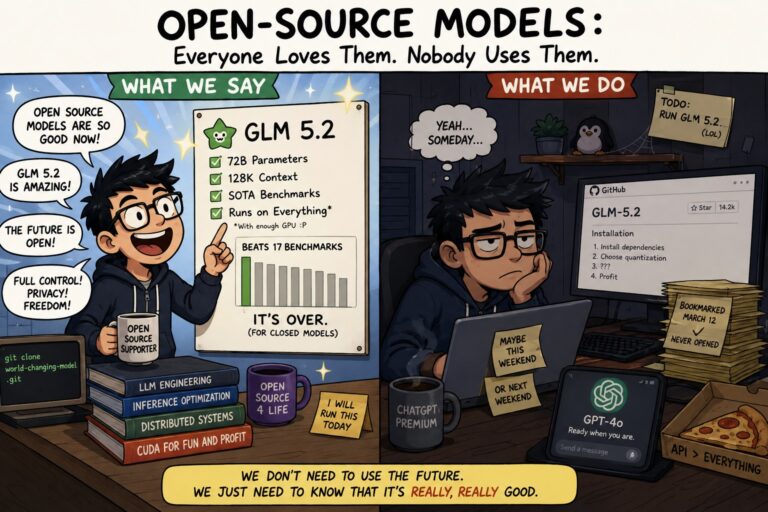
- You spend more time managing the tool than doing the task.
- You keep switching apps because the new one "feels" better.
- You feel a sense of accomplishment from a clean dashboard, even though your actual output is zero.
Optimization should be a means to an end. It is the grease on the gears. If the grease becomes more important than the machine itself, you have a problem.
The Perfectionism Loop
Deep down, many of us are just perfectionists in disguise.
If we can make the system perfect, maybe the work will be easier. Maybe if the workflow is flawless, we won't feel so overwhelmed by the actual work. We think that if we can just find the "perfect" setup, our procrastination will magically vanish.
But perfection is a moving target. There is always a new plugin, a new shortcut, or a newer version of a software. If you wait for the perfect system to start working, you will be waiting forever.
Life is messy. Work is messy. Real progress usually happens in a slightly chaotic environment where things are being built, broken, and fixed on the fly.
Getting Back to the Work
If you feel like you are stuck in an endless loop of tweaking and adjusting, stop. Close the "Settings" tab. Minimize the dashboard.
Ask yourself one simple question: "If I couldn't use this tool today, what would I actually have to do to finish my goal? "
The answer to that question is your real work. Everything else is just decoration.
It is okay to build systems. Good systems save lives and sanity. But remember that a hammer is only useful if you actually build something with it. Otherwise, you're just a person standing in a room, very intensely looking at a hammer.
Don't let the tools become the task.