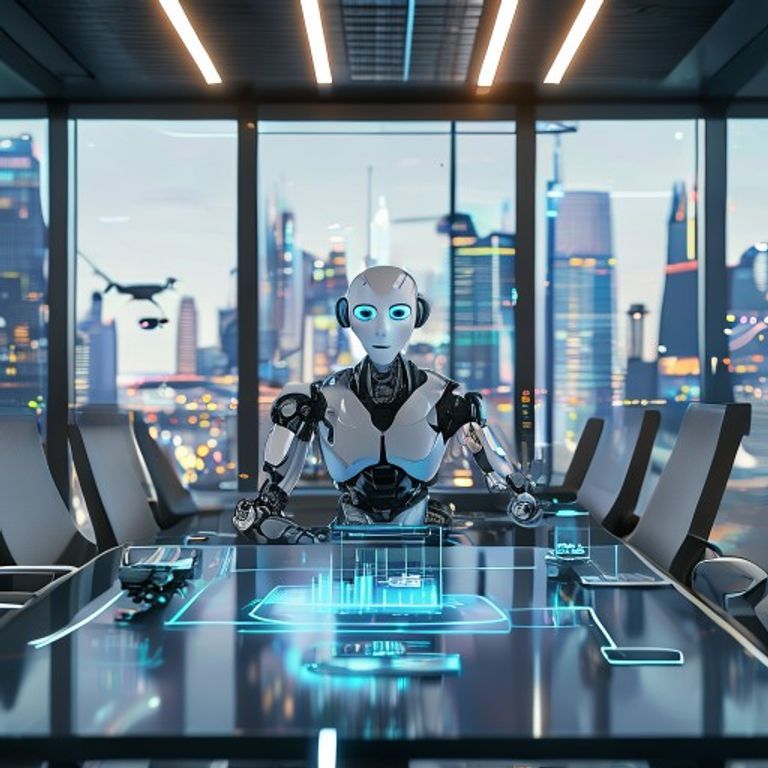
When AI Starts Owning Companies
Most governments are still stuck in a familiar phase of the AI conversation. They are arguing about safety frameworks, copyright disputes, labor disruption, misinformation, and how much regulation should arrive before systems become too powerful to control. It is a conversation rooted in caution, bureaucracy, and institutional instinct. Then Javier Milei arrived with something that feels almost pulled from speculative fiction: what if AI itself could run companies?
The proposal coming out of Argentina is not simply about reducing regulation. Plenty of countries compete on that axis already. What makes this different is the attempt to rethink the legal structure of economic life itself. Milei’s idea of “non-human corporations” suggests a world where AI agents or robotic systems could receive legal recognition and limited liability protections, operating businesses as autonomous entities rather than as tools fully controlled by human managers.
At first glance, the idea sounds absurd. Then, after sitting with it for a while, it starts to feel strangely inevitable.
The modern corporation was itself once considered an unusual invention. Centuries ago, economic life revolved around individual merchants, families, kingdoms, and guilds. The emergence of limited liability corporations fundamentally changed civilization because it created a legal fiction powerful enough to coordinate capital, labor, and risk at massive scale. Corporations became entities that could outlive founders, own property, enter contracts, and operate across borders. They were not people, but society agreed to treat them as something close enough for commerce to function.
Milei is essentially arguing that AI may require another leap of legal imagination. Not because machines are conscious or deserving of rights in a moral sense, but because autonomous systems may soon become economically useful enough that existing corporate structures start feeling inefficient. If an AI agent can negotiate contracts, manage inventory, optimize logistics, write software, market products, respond to customers, and allocate capital faster than human teams, then eventually someone will ask an uncomfortable question: why force humans to remain legally central to operations that are increasingly automated?
That question feels distant until you look around carefully at how work already functions. Many businesses today are surprisingly procedural. A small e-commerce store can already operate with software handling advertising, pricing, fulfillment, accounting, customer service, and procurement. One human often sits vaguely “on top” of systems they barely touch day-to-day. In some startups, the founder becomes less of an operator and more of a legal requirement.
The AI company proposal pushes that trajectory one step further. Imagine a logistics company where AI agents continuously negotiate shipping rates, manage fleets of autonomous vehicles, handle customs documentation, optimize routes, and reinvest profits. Human involvement might become intermittent rather than central. The legal shell of the corporation would still exist, but its operational intelligence would increasingly belong to software.
What makes Argentina fascinating in this moment is not simply the proposal itself, but the broader economic context surrounding it. Countries with stable institutions and mature economies tend to move cautiously because they already have systems worth protecting. Nations dealing with stagnation, debt crises, inflation, or structural economic weakness sometimes become more willing to experiment aggressively. There is less attachment to preserving the status quo when the status quo has not been delivering stability anyway.
That dynamic appears repeatedly throughout history. Financial innovation often emerges from pressure rather than comfort. Places struggling to attract capital become laboratories for unconventional policy. Singapore, Dubai, Estonia, Ireland, and others all used regulatory flexibility at different moments to position themselves as hubs for emerging industries. Argentina may be attempting something similar for AI.
There is also a deeper philosophical layer beneath this proposal that people may underestimate. Much of modern society still quietly assumes humans remain the unquestioned center of economic systems. Even highly automated corporations are legally understood as collections of human interests. But AI challenges that assumption because intelligence itself begins separating from biological identity.
That sounds abstract until you think about ordinary workplace reality. In many offices today, employees already receive instructions from systems rather than from people. Algorithms schedule drivers, rank workers, determine advertising budgets, filter resumes, approve loans, prioritize deliveries, and optimize warehouse movement. Humans increasingly adapt themselves around machine-generated decisions. The authority structure has already started shifting culturally, even before law formally recognizes it.
One reason this proposal unsettles people is because corporations already feel strangely inhuman at times. Anyone who has spent years inside large organizations knows the sensation. Decisions emerge from systems nobody fully controls. Incentives propagate through layers of bureaucracy. Individual morality becomes diluted by process. A corporation can behave intelligently without anyone inside fully understanding why certain outcomes occur.
Now imagine adding AI optimization directly into that structure.
The result could produce extraordinary efficiency. It could also amplify some of capitalism’s coldest tendencies. Human-run organizations at least contain friction: emotions, hesitation, politics, empathy, exhaustion, social pressure, reputation concerns, and personal conscience. Autonomous AI entities might pursue objectives with relentless consistency. If incentives are poorly designed, the consequences could become difficult to predict.
This is where the conversation becomes more complicated than simple techno-optimism or fear.
Supporters of Milei’s vision will argue that innovation flourishes when governments avoid overregulation. There is truth in
A more permissive environment could attract founders who feel suffocated elsewhere. Argentina might become a jurisdiction where entrepreneurs test radically automated organizational models impossible under more conservative legal systems. Venture capital tends to flow toward regulatory asymmetry. If one country allows experiments others prohibit, talent eventually notices.
But legal innovation also creates new vulnerabilities.
The modern corporation works because accountability, however imperfect, still traces back to humans. Boards can be sued. Executives can face criminal liability. Owners can lose capital. Governments can regulate behavior through identifiable actors. Once organizations become partially autonomous, responsibility starts becoming blurry.
If an AI-controlled company commits financial fraud, who goes to court? If an autonomous logistics network causes physical harm, who bears moral responsibility? If an AI corporation destabilizes markets through hyper-optimized behavior, who intervenes? The legal system struggles even now with algorithmic accountability in relatively narrow contexts. Fully autonomous firms would multiply that complexity dramatically.
There is another quieter issue beneath the surface as well: labor.
Technology discussions often frame automation as a future disruption, but many workers already feel the psychological pressure of partial replacement. Junior employees in law, design, software, marketing, and media increasingly wonder which parts of their profession remain distinctly human. The anxiety is not always about immediate unemployment. Often it is about bargaining power, career progression, and long-term relevance.
Non-human corporations symbolically intensify that fear because they move automation from being a tool inside firms to becoming the firm itself.
That shift matters psychologically. Humans tolerate technology more easily when it appears subordinate. A machine assisting workers feels different from a machine legally operating beside them in the economy. Even if practical outcomes overlap, the symbolic message changes. It suggests society no longer sees human management as necessary for economic coordination.
At family dinners, this conversation already appears in smaller forms. Parents encourage children toward “safe” careers while quietly suspecting no profession feels entirely safe anymore. Young workers learn software tools with both excitement and dread. Managers experiment with automation while reassuring teams that human creativity still matters. There is a strange emotional duality emerging across knowledge work: admiration for AI capability mixed with uncertainty about where humans fit long term.
Milei’s proposal does not create that tension. It simply makes it harder to ignore.
Interestingly, the strongest resistance may not come from workers alone. Existing corporations themselves may become uneasy with truly autonomous competitors. Traditional firms carry social obligations, employment costs, governance structures, legal exposure, and human inefficiencies. AI-native organizations could theoretically operate continuously, globally, and at dramatically lower overhead.
That creates a possibility rarely discussed openly: AI may not merely disrupt labor markets. It may disrupt the corporation as a human institution.
For centuries, firms existed partly because humans needed organizational structures to coordinate intelligence at scale. Meetings, management hierarchies, reporting systems, departments, and bureaucracies all evolved around human cognitive limits. AI potentially alters those constraints. An autonomous organization may not require the same layers of coordination because decision-making itself becomes computational.
That does not mean human companies disappear. People still trust people emotionally. Relationships, reputation, culture, and human judgment remain economically valuable. But it may create a bifurcation where some sectors become heavily autonomous while others emphasize human-centered value even more strongly.
The historical comparison Milei invokes is actually useful here. Early corporations transformed trade not because society philosophically agreed on their moral status, but because they solved practical coordination problems during a period of expanding global commerce. The legal framework followed economic necessity.
AI may create similar pressures. If autonomous systems become economically indispensable, governments will eventually adapt legal structures around them regardless of current discomfort. The real question is not whether experimentation happens, but where and under what constraints.
That is why Argentina’s move matters globally even if the proposal never fully succeeds. It shifts the conversation window. Once one country seriously discusses AI-run corporations, others must at least consider the implications. Investors, entrepreneurs, regulators, and academics begin modeling scenarios that previously felt too strange to entertain publicly.
There is also something emotionally revealing about this moment. Humanity has spent centuries building systems designed to amplify productivity, scale coordination, and reduce dependence on individual human limitations. AI may simply represent the logical continuation of that trajectory. Yet now that the possibility becomes tangible, many people instinctively recoil. Somewhere deep down, society still wants economic life to remain recognizably human.
That tension may define the next decade more than technical capability itself.
Because beneath all the policy debates, something larger is unfolding. The question is no longer merely whether machines can think, create, or optimize. The question is whether societies are willing to reorganize institutions around non-human intelligence once doing so becomes economically advantageous.
And history suggests economics often moves faster than philosophy.
Long before societies fully understand the moral implications of new systems, competitive pressure usually pushes adoption forward anyway. Companies automate because rivals automate. Governments compete because other governments compete. Investors chase efficiency because markets reward efficiency. Then culture, law, and ethics scramble afterward trying to catch up.
Argentina may simply be saying the quiet part out loud earlier than everyone else.
- Top-rated Robotics in logistics solutions resources
- Master AI-driven supply chain optimization tools with these resources
- Recommended products for AI ethics and law courses online
- Get started with Digital transformation consulting services
- Essential Legal implications of artificial intelligence references



