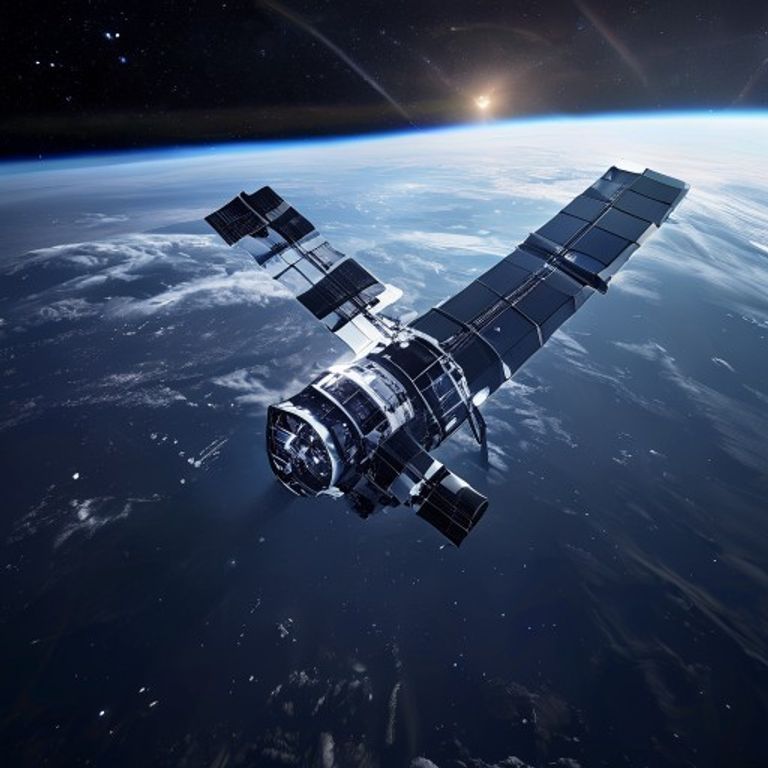
A futuristic AI-focused satellite with glowing internal components orbits above Earth, reflecting the sun's harsh light against the dark, star-filled void of space.
For years, the technology industry has treated data centers like modern industrial palaces.
Massive buildings. Endless rows of GPUs. Cooling towers humming through the night. Entire regions reshaped around electricity, fiber connectivity, and water access. In places like Northern Virginia, the desert outside Phoenix, and parts of rural Texas, artificial intelligence is already transforming geography itself.
Now imagine someone looking at all of that infrastructure and saying: what if the future of AI isn’t on Earth at all?
That is the provocative idea behind SpaceX’s reported “Starmind” project — a proposed constellation of AI-focused satellites capable not just of transmitting information like Starlink, but actually computing in orbit.
If the vision materializes anywhere close to its ambition, it could become one of the strangest and most consequential infrastructure bets of the AI era.
Not because it replaces data centers overnight. It probably won’t. But because it changes where humanity thinks computation belongs.
From Internet Pipes to Orbital Computers
The conceptual leap from Starlink to Starmind is easy to miss at first.
Starlink satellites are essentially networking hardware in space. Their job is to move data quickly across the planet. They are extraordinarily sophisticated routers with antennas and laser links.
Starmind, however, appears to aim at something much more radical: turning satellites themselves into distributed AI compute nodes.
That means onboard processors powerful enough to run inference workloads directly in orbit. Instead of sending your AI request down to a terrestrial hyperscale data center, processing it there, and routing it back, the satellite itself could handle part of the task.
In simple terms: the satellite becomes the server.
That distinction matters.
Right now, the AI industry is running into very physical limits. Electricity constraints. Cooling challenges. Grid bottlenecks. Land acquisition battles. Community backlash over water use. Semiconductor shortages. Even local politics.
Modern AI infrastructure increasingly looks less like software and more like heavy industry.
And heavy industry eventually runs into friction.
A parent in suburban Arizona might not care about cloud infrastructure in theory. But they may care when a new AI facility strains local water supplies during a heatwave. A small town may welcome jobs at first, then realize its skyline now glows with warehouse-scale server campuses running 24 hours a day.
The invisible internet is becoming visibly physical.
Starmind’s promise is partly an attempt to escape those constraints.
The Seductive Logic of Space-Based AI
On paper, the argument has a certain ruthless elegance.
Space offers nearly continuous solar energy exposure. Cooling in vacuum environments can theoretically avoid some terrestrial thermal limitations. Satellites bypass geographic bottlenecks and can serve remote regions directly. Latency could improve in some networking scenarios due to line-of-sight communication and laser interconnects.
Most importantly, orbital computing shifts the political geography of AI.
A government can regulate land. It can block power permits. It can delay construction approvals. It can fight over environmental impact assessments.
Regulating a million-node orbital compute network is a different problem entirely.
That possibility alone will make regulators uneasy.
There is also an economic incentive that fits Elon Musk’s broader worldview. Musk consistently gravitates toward vertically integrated systems: Tesla controls batteries, software, manufacturing, charging networks, robotics, and increasingly AI infrastructure. SpaceX controls rockets, launch economics, satellites, and communications.
Starmind extends that philosophy into computation itself.
Imagine a future where SpaceX launches its own AI compute infrastructure, powered by its own satellites, transported by its own rockets, connected through its own communications network, and potentially running xAI models.
That is not merely a product. That is an ecosystem attempting to become sovereign infrastructure.
Silicon Valley companies historically rented infrastructure from others. Musk increasingly appears interested in owning the stack from orbit to inference.
But Physics Still Has Opinions
The headlines make the concept sound almost inevitable. The engineering reality is far messier.
Running meaningful AI inference in space is brutally hard.
Heat management alone becomes a nightmare at scale. Contrary to popular intuition, space is not naturally “cold” in a way that conveniently cools computers. In vacuum environments, there is no air to carry heat away through convection. Systems must radiate heat outward, which becomes increasingly difficult as compute density rises.
And AI chips generate astonishing amounts of heat.
NVIDIA’s latest AI accelerators already push power and thermal requirements to uncomfortable extremes on Earth, where cooling infrastructure includes liquid systems, industrial HVAC equipment, and enormous energy budgets.
Now imagine debugging thermal throttling 500 kilometers above the planet.
Radiation is another issue. Consumer electronics fail in orbit far faster than people realize. Space-grade hardware is expensive precisely because cosmic radiation slowly corrupts systems over time. Memory errors, processor degradation, and component fatigue are routine realities.
Even maintenance becomes philosophical.
When a terrestrial server rack fails, a technician walks over with a replacement part and perhaps a cup of coffee. When an orbital AI node fails, the repair strategy might involve autonomous servicing robots, satellite replacement launches, or simply letting dead units accumulate in orbit.
The economics become very different very quickly.
There is a reason cloud computing evolved inside buildings rather than in space despite humanity having satellites for decades.
The Bigger Story Is Energy
Underneath the spectacle, Starmind reflects a deeper truth about the AI industry: compute hunger is becoming civilization-scale.
Every major AI company now faces the same
A teenager generating anime avatars on a phone app seems harmless enough. But multiply billions of AI interactions across coding assistants, autonomous agents, enterprise automation, robotics, and video generation, and suddenly the global energy equation changes.
The industry spent years talking about algorithms. It is now talking about gigawatts.
There is a quietly surreal scene playing out across the tech world right now. AI executives who once obsessed over user growth and software frameworks are suddenly discussing nuclear power, transmission infrastructure, transformer shortages, and utility negotiations.
Some are even reopening conversations around small modular reactors.
That shift matters because it reveals something uncomfortable: the limiting factor for AI may no longer be intelligence research itself. It may be infrastructure.
Starmind can be understood as a response to that bottleneck.
Instead of competing for finite terrestrial energy resources, orbital systems attempt to tap directly into abundant solar exposure.
In other words, the proposal is not just about space. It is about escaping Earth’s infrastructure ceilings.
A Million Satellites Changes More Than AI
The scale reportedly described — up to one million satellites — is staggering.
Even if the final number ends up far smaller, the ambition itself reveals where technological thinking is heading: toward planetary-scale computation networks.
But that scale introduces consequences beyond AI performance.
Space debris becomes a far more serious concern. Astronomers already complain about Starlink interfering with observations. Orbital congestion is becoming an increasingly sensitive geopolitical and scientific issue.
Now add compute-heavy satellites with larger power systems and potentially shorter operational lifespans.
The environmental irony is difficult to ignore. Some future AI systems might help optimize energy usage on Earth while simultaneously contributing to orbital pollution above it.
And then there are military implications.
Distributed orbital AI could become strategically important for communications, autonomous defense systems, intelligence analysis, disaster response, and battlefield coordination.
Historically, major infrastructure breakthroughs rarely remain purely civilian for long.
The internet itself evolved partly from military research. GPS did too.
Orbital AI infrastructure would almost certainly become geopolitically sensitive within years.
China would not ignore it. Nor would the Pentagon.
The Human Side of Orbital Intelligence
For ordinary people, the implications may arrive in quieter ways.
A farmer in rural India using a multilingual AI assistant without needing nearby cloud infrastructure. Emergency responders in disaster zones accessing real-time AI analysis after terrestrial networks fail. Autonomous ships in the Pacific communicating directly with orbital inference systems.
Those are meaningful possibilities.
But there is another side.
Centralized AI already concentrates enormous power among a handful of companies. Orbital AI infrastructure could intensify that concentration further. If a company controls not just the model, but also the communications layer and compute layer, dependency deepens.
A future student asking an AI tutor for homework help may never realize their interaction depends on a vertically integrated orbital infrastructure owned by one corporation.
The convenience becomes invisible.
So does the dependency.
There is also a subtle psychological dimension to all of this.
Human beings historically associated “the cloud” with abstraction. Ethereal, distant, intangible.
Ironically, cloud computing was always extremely physical. It lived in giant buildings consuming rivers of electricity.
Starmind makes the metaphor literal again.
The cloud returns to the sky.
The Most Likely Outcome Is Somewhere Between Hype and Transformation
It is tempting to frame Starmind in extremes.
Either it becomes the future of global AI infrastructure or it collapses under technical and economic realities.
History suggests the truth will probably land somewhere in between.
Space-based computing may prove highly useful for specialized workloads: remote regions, military communications, edge inference, disaster resilience, autonomous systems, maritime logistics, or low-latency global AI services.
But replacing terrestrial data centers entirely is another matter.
Earth-based infrastructure retains enormous advantages: easier maintenance, denser compute, cheaper upgrades, direct fiber connectivity, scalable cooling systems, and simpler energy distribution.
Data centers are not disappearing anytime soon.
Yet that does not make the idea insignificant.
Many transformative technologies begin as seemingly impractical extensions of existing systems.
Early automobiles looked inferior to horses in reliability. Early smartphones seemed unnecessary to people satisfied with laptops and flip phones. Early reusable rockets were widely mocked.
The important question is not whether Starmind perfectly fulfills Musk’s rhetoric.
The important question is whether it nudges the trajectory of computing toward space in ways that gradually become economically compelling.
And strangely enough, that possibility no longer feels entirely absurd.
A Future Written Above Our Heads
There is something almost poetic about this moment.
Human civilization spent decades moving intelligence into machines. Then it concentrated those machines into giant terrestrial facilities. Now some technologists are contemplating scattering cognition itself across orbit.
A child sitting in a remote village years from now might casually ask an AI assistant for medical advice, language translation, or engineering help without realizing the computation happened hundreds of kilometers overhead.
That future could feel miraculous.
Or unsettling.
Possibly both at once.
Because Starmind is ultimately not just a story about satellites.
It is a story about the next phase of technological ambition.
The AI race is no longer confined to software labs. It is becoming a contest over energy systems, infrastructure control, planetary networking, semiconductor supply chains, and now perhaps orbital territory itself.
The real significance of Starmind may not be whether Earth’s data centers become obsolete.
It may be that humanity has started looking at the sky and seeing not just communication networks or exploration opportunities — but the next location for civilization’s computational brain.



