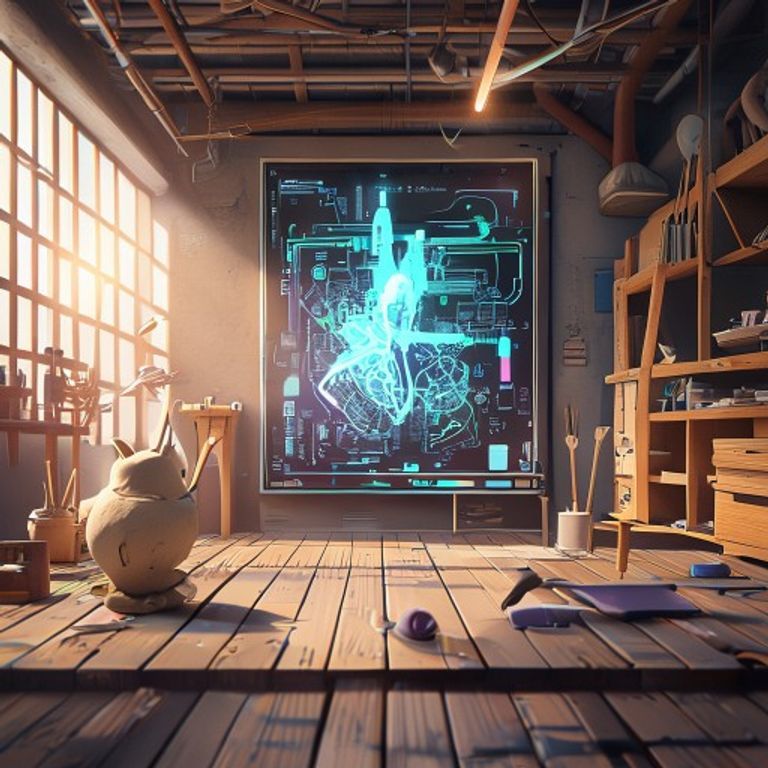
A cartoon scene depicting a futuristic AI art generator creating a complex digital masterpiece, juxtaposed with a simple, unfinished clay sculpture on a wooden workbench, illustrating the contrast between advanced AI creativity and intrinsic human artistic expression.
There was something unusually honest in Ohuenko’s recent interview about AI, creativity, and working on Telegram Gifts. Not because the ideas themselves were shocking. By now, most people in technology quietly suspect that AI will eventually outperform humans across an uncomfortable number of creative and intellectual domains. What felt different was the emotional tone underneath it. The conclusion wasn’t triumphant or dystopian. It was strangely calm.
The idea was simple: if machines eventually become better than humans at almost everything, the remaining reason to create is because you genuinely love creating.
That sounds obvious at first. Almost cliché. But the longer you sit with it, the more unsettling it becomes. Modern economies are built around the opposite assumption. People are taught that creativity is valuable because it produces status, money, influence, recognition, leverage, career mobility, or social identity. Very few people are encouraged to create simply because the act itself matters to them internally.
For years, the creative economy sold a dream that passion and monetization could permanently align. Platforms reinforced it. Social media reinforced it. Entire industries appeared around turning hobbies into brands and personalities into scalable businesses. The artist became a content creator. The writer became a media company. The musician became an algorithm manager. Even ordinary people slowly absorbed the logic that every interest should eventually justify itself economically.
AI quietly destabilizes that psychological contract.
What makes this moment emotionally difficult is not merely automation. Humans have adapted to automation before. Factories automated physical labor. Software automated clerical work. Logistics systems automated coordination. But creative work occupied a special emotional category in modern culture. People believed creativity was the final refuge of uniquely human value. Even those skeptical about technology often assumed art, imagination, emotional nuance, and visual storytelling would remain deeply human territories.
Now that assumption looks increasingly fragile.
What Ohuenko seems to recognize — and many artists privately recognize too — is that AI already functions less like a tool and more like an amplification layer for imagination itself. For visual artists especially, the speed difference is impossible to ignore. An idea that once required days of sketching, iteration, rendering, revision, and experimentation can now be explored in minutes. Entire aesthetic directions can be tested before lunch.
That changes not only productivity. It changes the emotional relationship between thought and execution.
Historically, technical skill acted as a gatekeeper between imagination and reality. A person might carry vivid creative visions internally for years yet lack the ability to express them effectively. The painter needed training. The animator needed years of craft development. The designer needed software mastery. Much of human creative life was bottlenecked by execution capability.
AI weakens that bottleneck dramatically.
There is something beautiful about this democratization. But there is also something destabilizing. When execution becomes nearly frictionless, society starts reevaluating what “talent” even means. That creates quiet identity crises across creative industries. Not always publicly. Often privately, during late-night conversations between designers, illustrators, editors, musicians, or filmmakers who suddenly realize the skills they spent fifteen years refining may no longer occupy the same economic position.
People sometimes underestimate how emotionally disorienting this feels because they view creativity too abstractly. But creative work is not merely output. It becomes intertwined with self-respect, routine, friendships, lifestyle, and personal meaning. Someone who spent decades becoming “the person who could do this difficult thing” now faces tools that collapse portions of that difficulty almost overnight.
The reaction is rarely simple fear. It is often grief mixed with fascination.
You can already see the contradiction emerging inside studios, agencies, and independent creator communities. Publicly, many people emphasize that “AI can never replace human creativity.” Privately, many of the same people are integrating AI into daily workflows because refusing to do so increasingly feels professionally irresponsible. The tension is not hypocrisy so much as emotional adaptation happening in real time.
And honestly, the tools are impressive. Even skeptics feel it once they spend enough time with them.
A designer experimenting with composition ideas. A writer brainstorming structures. A game artist exploring visual moods. A filmmaker prototyping scenes. A sticker creator testing emotional expressions for digital characters. AI does not simply accelerate labor. It expands exploratory bandwidth. People can think wider because iteration becomes cheaper.
That may be the most underestimated effect of AI in creative work. The future may not belong only to those with the highest technical execution skills. It may increasingly belong to people with unusual taste, emotional clarity, conceptual judgment, and the ability to recognize what feels meaningful amid infinite generation.
Ironically, abundance increases the value of discernment.
This is where the conversation becomes more philosophical than technical. Because once AI can generate nearly infinite competent output, human attention becomes the scarce resource. And humans do not actually connect deeply with content merely because it is technically impressive. They connect through resonance, context, identity, timing, vulnerability, humor, memory, and shared emotional texture.
That explains why imperfect human creations still matter even in environments saturated with machine-generated excellence.
A child’s drawing still matters to a parent despite objectively inferior execution. A rough voice memo from a friend still feels intimate. An awkward independent film can feel more emotionally alive than a flawless corporate production. Humans are not purely optimization machines. Emotional attachment operates through relationships and meaning, not just quality metrics.
But economic systems do optimize aggressively. That distinction matters.
When Ohuenko says AI may outperform humans at almost everything, he is probably directionally correct in many commercial contexts. Businesses optimize for efficiency, scale, speed, consistency, and cost reduction. If AI can produce acceptable creative assets faster and cheaper, many organizations will adopt it heavily regardless of philosophical discomfort.
This does not require AI to become spiritually profound. It only needs to become
That threshold is already arriving across parts of the digital content ecosystem.
Stock imagery has changed. Marketing workflows are changing. Illustration pipelines are changing. Translation, editing, copywriting, and video production are changing. Even areas once thought relatively insulated now feel pressure. The internet itself may soon become flooded with competent synthetic media generated at scales human creators cannot realistically compete with.
Which creates another strange paradox.
The easier content becomes to generate, the harder genuine attention becomes to earn.
For years, internet culture rewarded volume. More posts. More clips. More uploads. More engagement. But audiences are already showing signs of exhaustion. People increasingly crave signals of authenticity, intentionality, and actual human presence because abundance has made synthetic engagement emotionally numbing.
You can feel this socially now. Someone shares a polished AI-generated image online, and people briefly admire it before scrolling away seconds later. Technically impressive. Emotionally thin. Meanwhile, a blurry photo from a real moment between friends can still linger in memory all day.
That difference matters more than many technologists initially expected.
The future probably does not split cleanly into “AI replaces humans” versus “humans defeat AI.” Real life is messier. More likely, human creativity becomes partially redefined around curation, emotional perspective, aesthetic judgment, and relational trust. Machines may generate infinite possibilities, but humans still decide what feels culturally alive.
At least for now.
Still, it would be naive to pretend this transition will feel painless. Entire generations built careers under assumptions that are now shifting rapidly. Young artists entering creative industries today face radically different incentives than those entering fifteen years ago. Technical mastery alone no longer guarantees scarcity value. That forces uncomfortable questions about education, professional identity, and economic sustainability.
Some people will adapt enthusiastically. Others will quietly disengage. Many will oscillate between excitement and despair depending on the day.
And beneath all the productivity discussions lies a deeper existential question that technology rarely likes to confront directly: what happens when human excellence stops being economically necessary?
Modern identity is heavily achievement-oriented. People derive dignity from being useful, skilled, employable, admired, productive, or difficult to replace. AI destabilizes that framework because it introduces the possibility that many forms of excellence may eventually become abundant rather than scarce.
That does not automatically make human life meaningless. But it does force societies to rethink where meaning actually comes from.
For some people, that realization becomes liberating. If a machine can outperform everyone eventually, maybe the pressure to constantly optimize oneself weakens. Maybe creativity becomes more playful again. Maybe hobbies stop needing business models. Maybe making strange little things for small groups of people becomes enough.
For others, the same realization feels terrifying because it strips away traditional markers of value and status.
Both reactions are understandable.
There is also an irony hiding inside AI discourse that often goes unnoticed. Many of the people building these systems are themselves deeply motivated by creative fascination. Engineers training generative models often sound emotionally similar to artists discussing craft. They experiment obsessively, chase elegance, refine outputs, share discoveries with peers, and become consumed by curiosity.
In other words, even the systems threatening portions of human creativity emerged from profoundly human creative impulses.
That contradiction says something important about technology history more broadly. Humans rarely build transformative tools purely for efficiency. They build them because exploration itself is pleasurable. Curiosity drives civilization as much as economics does.
Which brings the conversation back to Ohuenko’s central point.
If AI eventually becomes astonishingly capable, then intrinsic motivation matters more, not less. The people who continue creating sustainably may not be those chasing external validation alone. They may be the people who genuinely enjoy the process of shaping ideas into experiences regardless of comparative superiority.
That sounds romantic until you realize how difficult modern systems make this mindset. Most digital platforms reward visibility metrics relentlessly. Creative work becomes entangled with performance analytics, follower counts, monetization pressures, and algorithmic incentives. People stop asking “Do I enjoy making this?” and start asking “Will this perform?”
AI intensifies that tension because it accelerates production velocity beyond human psychological comfort.
Perhaps that is why smaller, more intimate forms of digital expression still feel emotionally refreshing. Telegram stickers. Niche communities. Inside jokes. Personal art shared among friends. Tiny internet cultures that prioritize connection over optimization. These spaces preserve something increasingly rare online: the feeling that creation can still be playful instead of purely strategic.
The future of content may become strangely bifurcated. On one side, oceans of infinitely generated commercial media optimized by algorithms. On the other, smaller human spaces where people gather precisely because imperfection, personality, and emotional texture still matter.
And maybe both worlds coexist longer than people expect.
Technology discussions often become trapped between utopian hype and catastrophic panic. Real life tends to unfold more ambiguously. AI will almost certainly reshape creative work dramatically. Some professions will shrink. Some new forms will emerge. Some people will discover extraordinary empowerment through these tools. Others will feel displaced by them.
But underneath all the forecasts, humans will probably continue doing something very old and very stubborn: making things anyway.
Not always because it is profitable. Not always because it is efficient. Sometimes simply because expressing experience outward remains one of the deepest instincts humans have.
A grandfather carving wood despite factory furniture existing everywhere. A teenager making strange sticker art late at night. A musician uploading songs no algorithm requested. A designer experimenting with AI tools not to dominate markets, but because curiosity itself feels alive.
That impulse may survive longer than any specific technology cycle.
And perhaps that is the quiet truth underneath Ohuenko’s comment. AI may eventually surpass humans across astonishing domains. But loving the act of creation was never entirely about being the best in the first place. It was also about feeling connected to one’s own imagination while briefly sharing that experience with others.
Machines may become extraordinary creators.
But humans will probably keep creating for deeply human reasons anyway.



