For decades, mathematics occupied a special place in human culture.
It was seen as one of the last truly human intellectual frontiers. Writing could be assisted. Art could be imitated. Customer support could be automated. But mathematics – real mathematics – still carried an aura of sacred difficulty. The lonely genius at the chalkboard. The graduate student surviving on caffeine and stubbornness. The elegant proof that takes years to discover and only minutes to read.
Now even that boundary is beginning to blur.
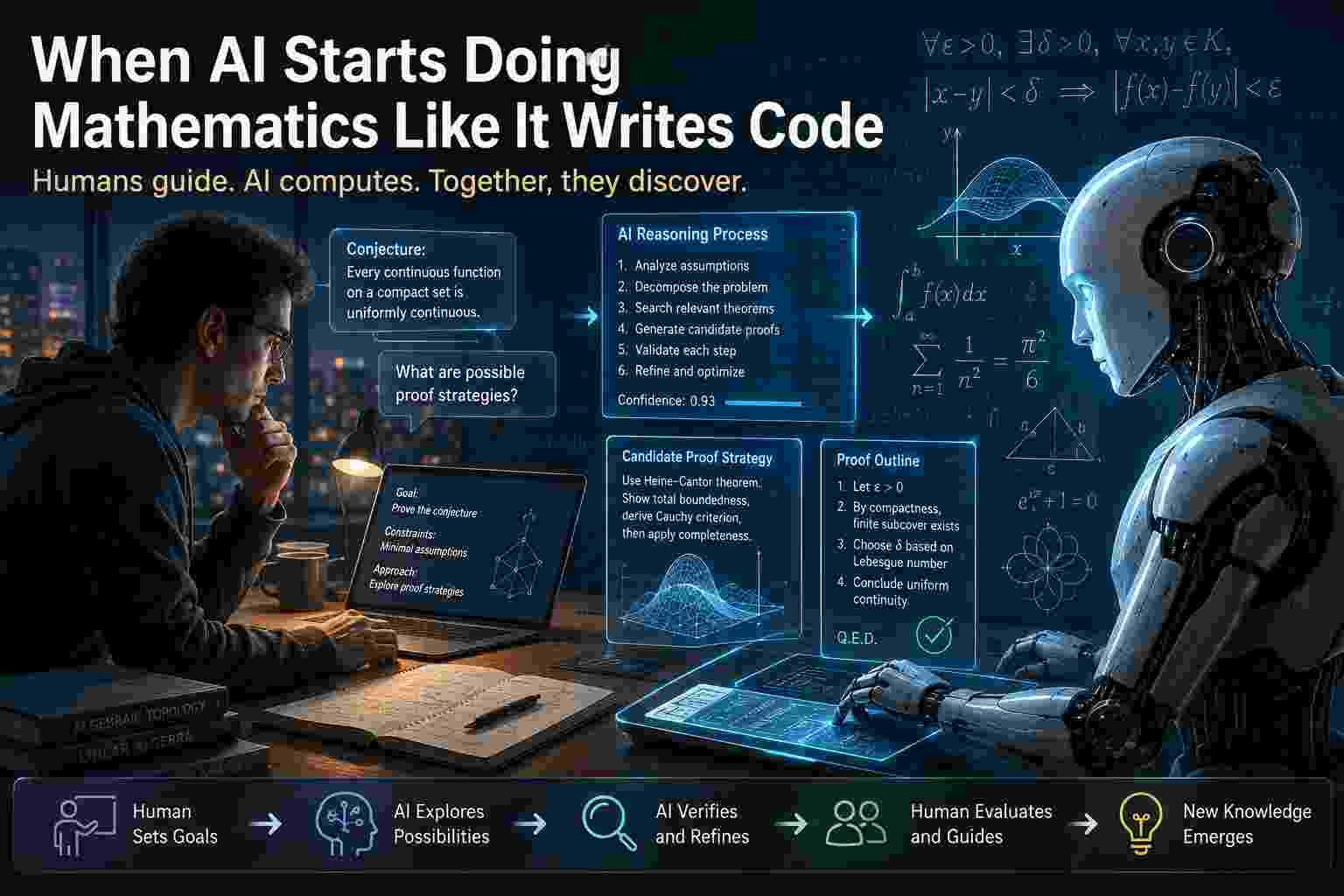
Recently, OpenAI researcher Noam Brown suggested that within a year or two, mathematics may start looking a lot like coding does today: humans guiding the process while AI systems do much of the mechanical and exploratory work.
At first glance, that sounds almost absurd. Mathematics is not autocomplete. It is not merely syntax. It is abstraction, creativity, intuition, rigor.
And yet, if you look closely at what is happening across the AI industry right now, Brown’s prediction no longer feels futuristic. It feels disturbingly plausible.
The Quiet Transformation of Intellectual Work
Something subtle has already happened in software engineering.
A surprising number of programmers no longer write code line-by-line from scratch. Instead, they supervise. They prompt. They inspect. They debug. They guide large language models through increasingly complex workflows.
The keyboard hasn’t disappeared. But the relationship between human and machine has changed.
You can see this in ordinary offices now.
A junior developer sits in a café in Bengaluru asking ChatGPT to scaffold an API. A startup founder in San Francisco uses Claude to review thousands of lines of legacy code before an investor demo. Somewhere in Seoul, a security researcher feeds dense documentation into an AI system at 2 a.m. because the product launch is tomorrow morning and nobody has time to manually trace dependencies anymore.
The engineer increasingly behaves less like a typist and more like a conductor.
Mathematics may be next.
Why Math Is Suddenly Vulnerable to AI
The surprising thing is not that AI can do arithmetic. We solved that long ago.
The surprising thing is that modern reasoning models are beginning to navigate symbolic abstraction in ways that resemble fragments of mathematical thinking.
That distinction matters.
Earlier AI systems often failed spectacularly at multi-step reasoning. They could sound intelligent while collapsing halfway through a proof. But newer systems increasingly break problems into chains of reasoning, test possibilities, backtrack, verify outputs, and explore solution paths iteratively.
In some ways, this resembles how mathematicians actually work.
Most mathematics is not a lightning bolt moment. It is wandering through dead ends.
A theorem might require hundreds of failed approaches before one elegant structure emerges. Human mathematicians constantly generate partial ideas, discard them, test assumptions, and refine abstractions. That kind of iterative search happens to align surprisingly well with how modern AI systems are evolving.
And importantly, mathematics is becoming computable in a new economic sense.
For years, AI progress depended heavily on scaling laws: more compute, more data, bigger models. But now companies are focusing aggressively on “reasoning time compute” – allowing models to spend more inference-time effort thinking through problems step by step.
This is where OpenAI’s broader strategic shift becomes important.
Sam Altman recently described OpenAI as entering its “third act,” where AI is no longer just a consumer product but a scientific acceleration engine. The company openly predicts that by 2028, AI systems may contribute meaningfully to AI research itself.
That sentence should make people pause.
Because once AI systems begin participating in scientific discovery, mathematics becomes infrastructure rather than merely an academic field.
And infrastructure gets automated aggressively.
The Strange Future of Human Mathematicians
This does not mean mathematicians disappear.
But their role may change in uncomfortable ways.
Think about architects after CAD software. Or photographers after digital cameras. Or journalists after search engines.
The profession survives. But the center of gravity shifts.
Imagine a graduate student in 2028.
She uploads a partially formed conjecture into an advanced reasoning system. The model generates twenty possible proof strategies overnight, identifies similarities to obscure papers published in the 1990s, simulates counterexamples, and highlights which branches appear most promising.
In the morning, her job is no longer brute-force exploration.
Her job is judgment.
Which directions are meaningful? Which abstractions matter? Which results are elegant versus merely computationally valid?
This sounds empowering. And it probably will be – at least initially.
But there is a deeper psychological shift underneath.
For centuries, intelligence itself carried social meaning. Mathematical ability especially functioned as a marker of exceptional cognition. Entire educational systems were built around filtering people through symbolic reasoning tasks.
What happens when machines become collaborators in those domains?
A teenager struggling through calculus homework may soon wonder whether mastering symbolic manipulation is even the point anymore. Parents may still push STEM careers, but the emotional prestige
We may eventually value taste, framing, creativity, and interdisciplinary thinking more than procedural mastery itself.
Ironically, mathematics could become more human precisely because AI absorbs more of the mechanical burden.
The Anthropic Question: Capability With Restraints
At the same time, the industry is becoming increasingly nervous about what these systems are capable of.
Anthropic’s recent releases illustrate this tension perfectly.
The company reportedly introduced sophisticated safeguards that selectively reduce model effectiveness in strategically sensitive areas like frontier AI development, cybersecurity, biology, and infrastructure replication.
That detail matters more than most people realize.
This is not simply content moderation anymore.
It is capability governance.
The model may answer your question while quietly steering itself away from being maximally useful in certain domains.
That creates a fascinating new reality: AI systems that dynamically adjust their intelligence depending on context.
Imagine how strange this becomes socially.
Two researchers could interact with the same underlying model and experience meaningfully different intellectual capabilities depending on permissions, institutional trust, or geopolitical restrictions.
The AI era may not simply divide people by wealth or access to hardware.
It may divide people by access to cognition itself.
And that raises uncomfortable questions about who controls advanced reasoning systems in the first place.
The Geopolitical Layer Nobody Can Ignore
OpenAI says powerful AI should be broadly distributed.
At the same time, American AI companies increasingly support restrictions on frontier model access for geopolitical rivals, especially China.
This contradiction is not accidental. It reflects the central tension of the AI age.
Everyone wants democratized intelligence.
Nobody wants their adversaries to have more of it.
Historically, foundational technologies tend to centralize power before they decentralize it. Electricity, aviation, nuclear technology, semiconductors, and the internet all followed versions of this pattern.
AI may follow it too.
A country with dramatically superior reasoning systems could accelerate scientific research, optimize military logistics, dominate biotech discovery, automate software engineering, and influence global information ecosystems simultaneously.
This is why compute infrastructure suddenly matters so much.
Even SpaceX recently unveiled plans for AI-focused satellites optimized around massive power generation and compute payloads. That sounds bizarre until you realize the future AI economy may depend as much on energy and compute logistics as on algorithms themselves.
The next AI arms race may look less like social media competition and more like industrial infrastructure development.
Solar arrays. Cooling systems. Distributed inference networks. Dedicated AI data centers in orbit.
The future starts sounding strangely physical again.
The Bigger Human Story
Still, the most important effects may happen quietly in ordinary life.
A high school student asks an AI tutor to explain topology using football tactics.
An exhausted researcher uses AI to summarize 400 pages of papers before a conference deadline.
A small biotech startup discovers a promising molecular interaction because an AI system spotted a pattern no human noticed.
A lonely teenager falls in love with solving math problems because the machine finally explains concepts patiently without judgment.
These moments matter too.
The AI conversation often swings wildly between utopia and apocalypse. But most technological revolutions arrive as mundane behavioral shifts before they become historical narratives.
The smartphone did not initially feel like a civilizational event. It felt like checking maps while walking.
Then society reorganized itself around it.
AI may follow a similar trajectory.
The Real Risk Isn’t That AI Does Math
The real risk is that humans gradually stop understanding how much intellectual outsourcing is occurring.
There is a difference between using calculators and losing conceptual intuition altogether.
If future researchers rely heavily on AI-generated reasoning chains, verification may become the defining skill rather than original derivation. That sounds manageable until systems grow so complex that only other AI systems can realistically audit them.
At that point, society enters unfamiliar territory.
Not because humans become unintelligent.
But because cognition becomes layered, mediated, and partially opaque.
Much like modern finance.
Or modern software infrastructure.
Most people using cloud services today cannot explain distributed systems architecture. Yet civilization depends on it daily.
The same may eventually become true for machine-generated mathematics and scientific reasoning.
A Future That Feels Both Exciting and Uneasy
Noam Brown’s prediction sounds provocative because mathematics still symbolizes pure human intellect.
But history suggests that once a domain becomes economically valuable and computationally tractable, automation eventually arrives.
The deeper question is not whether AI will help do mathematics.
It almost certainly will.
The deeper question is what humans choose to become when intelligence itself becomes collaborative infrastructure.
Perhaps future mathematicians will resemble film directors more than solitary geniuses: orchestrating systems, refining outputs, choosing elegant paths among infinite possibilities.
Or perhaps entirely new intellectual professions emerge – people whose main skill is steering machine cognition toward meaningful discoveries.
Either way, something profound is changing.
And somewhere right now, probably in a dimly lit apartment with too many browser tabs open, someone is already using AI to solve a problem that would have taken weeks just a few years ago.
That is how technological eras begin.
Quietly at first.