A few decades ago, the idea would have sounded absurd.
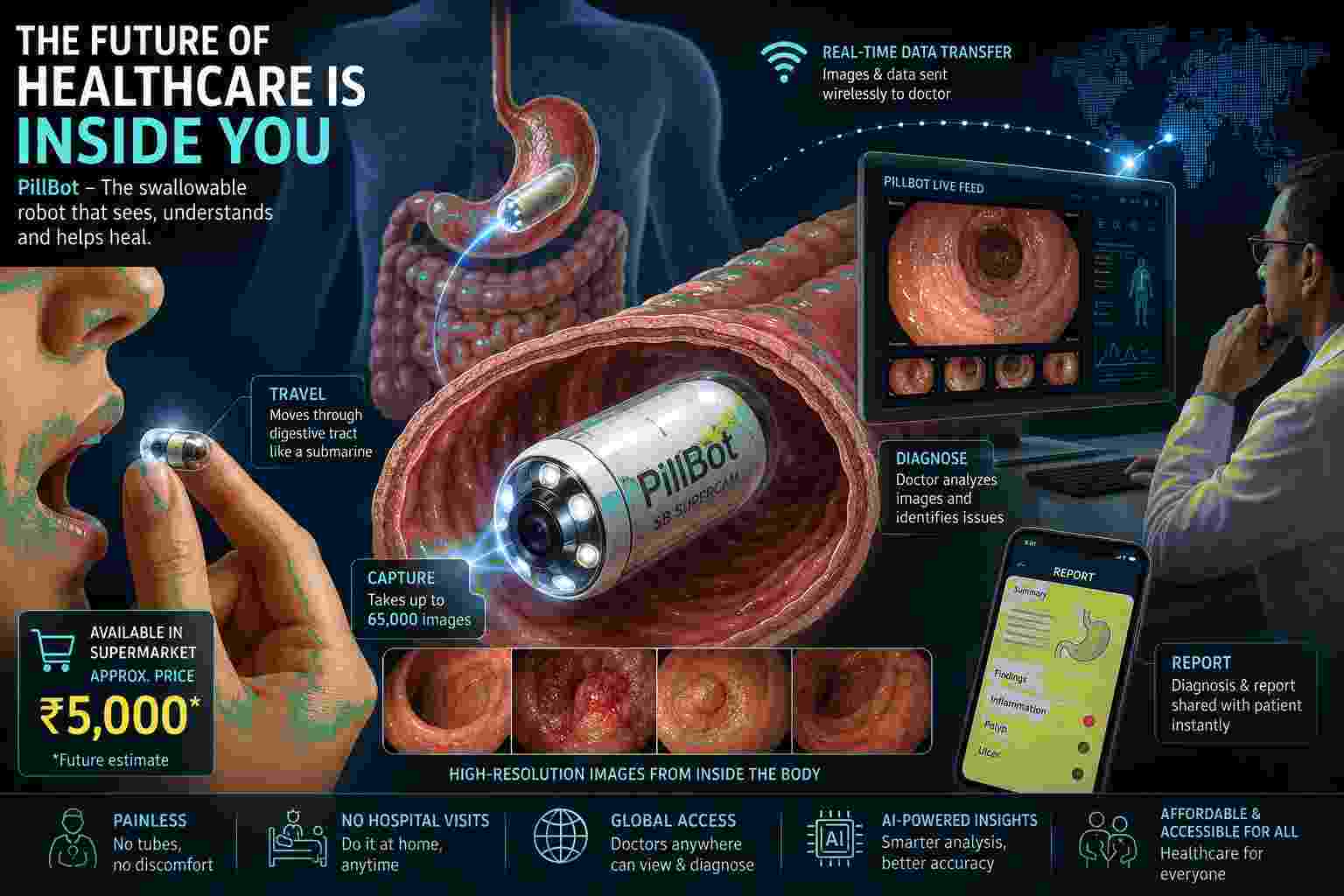
A patient walks into a supermarket pharmacy, buys a tiny robotic pill, swallows it with water, and a doctor sitting thousands of kilometers away watches live images from inside the patient’s stomach like a submarine camera exploring deep ocean terrain.
Not in a sci-fi movie. Not in a research lab hidden behind military contracts.
In a hospital in India.
That future quietly arrived at AIG Hospitals with the debut of PillBot, a swallowable robotic capsule developed by the American medical company Endiatx. The capsule can travel through the gastrointestinal tract, capture high-resolution images, and transmit them wirelessly to physicians.
And perhaps the most startling part is not the technology itself.
It’s the economics.
The creators claim future versions could eventually cost roughly $35–$60 per capsule — potentially under ₹5,000 in India.
That price changes the conversation entirely.
Because once advanced medical diagnostics become cheap, portable, and remotely accessible, medicine itself begins to change shape.
Medicine Has Always Been About Access
For most of human history, diagnosis depended on proximity.
If you lived near skilled doctors, you survived more often. If you lived far away, your options narrowed dramatically.
Even modern healthcare still operates under this geographical inequality. A specialist gastroenterologist is easy to find in Mumbai, Hyderabad, London, or Singapore. Much harder in a small town in Bihar, rural Africa, or parts of Latin America.
Traditional endoscopy also isn’t pleasant. It often involves sedation, invasive tubes, hospital infrastructure, expensive equipment, trained operators, sterilization systems, and patient anxiety.
Anyone who has waited nervously outside an endoscopy room knows the emotional reality of medical procedures. The fasting. The paperwork. The smell of disinfectant. The awkward silence while relatives scroll endlessly through WhatsApp in hospital corridors.
PillBot attacks that entire experience.
Instead of bringing the patient to the machine, the machine enters the patient.
That’s a profound shift.
Why This Tiny Capsule Matters More Than It Appears
On the surface, PillBot looks like another gadget in the growing “smart health” industry.
But underneath, it represents the convergence of several powerful technological trends:
- Miniaturized robotics
- Wireless communication
- Low-power imaging systems
- AI-assisted diagnostics
- Telemedicine
- Consumer-grade manufacturing economics
Individually, none of these are new.
Together, they become transformative.
A modern smartphone already contains astonishingly tiny cameras, sensors, batteries, and wireless chips. Medical robotics is now piggybacking on the same miniaturization revolution that made phones thinner and drones cheaper.
That’s why the submarine comparison feels so accurate.
We are essentially building tiny autonomous explorers for the human body.
And today it’s gastroenterology. Tomorrow it may be targeted drug delivery, micro-surgery, internal bleeding control, or cancer biopsy collection.
That’s the moment this stops being “advanced imaging” and starts becoming internal robotic medicine.
The Strange Democratization of Elite Healthcare
There’s another reason this story feels important.
Historically, cutting-edge healthcare technologies begin expensive and exclusive.
MRI machines. Robotic surgery. Genetic sequencing. AI diagnostics. They first appear in elite hospitals serving wealthy patients.
But PillBot hints at something different: consumerization.
Imagine a future family scenario.
A middle-aged schoolteacher in Nagpur experiences recurring stomach discomfort but postpones hospital visits for months because traveling to a metro city means lost wages, hotel costs, and endless appointments.
Instead, a local clinic hands him a sealed capsule.
He swallows it after breakfast.
An AI system flags suspicious tissue patterns automatically. A gastroenterologist in Hyderabad reviews the scan remotely later that afternoon.
Diagnosis begins before the patient has even left home.
That is not merely technological convenience.
That is healthcare decentralization.
And decentralization tends to reshape industries permanently.
But Here’s the Important Nuance: We Are Still Early
The hype around futuristic medical technology often skips over inconvenient realities.
Right now, PillBot is still undergoing clinical evaluation and regulatory processes. Medical technology is not consumer electronics.
If a smartphone crashes, it’s annoying. If a medical robot fails inside a patient’s body, the consequences can become life-threatening.
Regulatory systems move slowly because they are designed to protect human
And medicine has seen overhyped waves before.
Remember the early enthusiasm around IBM Watson for healthcare? Or Theranos promising revolutionary blood testing? Even AI diagnostic systems today still struggle with bias, edge cases, and clinical reliability in real-world environments.
Human bodies are messy systems.
Stomachs don’t behave like controlled laboratory pipelines. People move. Sensors fail. Data quality fluctuates. Anatomy differs dramatically across patients.
Hollywood fantasies rarely include battery constraints, wireless interference, reimbursement disputes, or insurance paperwork.
Reality does.
The Hidden Economic Earthquake
Still, even with those caveats, the economic implications are hard to ignore.
Healthcare globally suffers from a brutal imbalance:
- Demand is exploding
- Specialists are limited
- Costs keep rising
Countries like India face a particularly difficult challenge because the population scale is enormous while specialist access remains uneven.
If robotic capsule diagnostics become reliable and inexpensive, several industries could be disrupted simultaneously:
- Traditional diagnostic centers
- Hospital infrastructure models
- Medical tourism
- Insurance workflows
- Doctor training pathways
A junior doctor in a tier-2 city might eventually rely on AI-assisted capsule diagnostics reviewed remotely by senior specialists elsewhere.
This creates an interesting paradox.
Technology could both centralize and decentralize medicine at the same time.
The expertise becomes centralized.
The access becomes decentralized.
That’s very similar to what happened with cloud computing.
The AI Layer Changes Everything
The real long-term story may not be the capsule itself.
It may be what analyzes the data.
One PillBot session can reportedly generate tens of thousands of images. Humans reviewing all of them manually is expensive and time-consuming.
AI thrives in exactly these environments: massive image datasets, repetitive pattern recognition, anomaly detection.
Radiology already uses AI-assisted systems to identify tumors, fractures, and abnormalities. Gastroenterology is likely next.
Now imagine combining:
- Ingestible robotics
- Real-time wireless imaging
- AI interpretation
The result starts looking less like a hospital procedure and more like a continuous health monitoring platform.
That opens uncomfortable questions too.
Who owns the internal images of your body?
Where are they stored?
Can insurance companies demand access?
Could employers someday require preventive diagnostic scans?
The more medicine becomes digitized, the more healthcare starts inheriting the same privacy tensions we already experience with smartphones and social media.
The body itself becomes data infrastructure.
That idea still feels emotionally strange to many people.
India’s Role in the Next Medical-Tech Wave
There’s also a larger geopolitical angle here.
India is becoming an increasingly important testing ground for affordable healthcare innovation.
Not because healthcare problems are simple here — quite the opposite.
India’s scale forces efficiency.
If a medical technology works affordably in India, it often becomes globally scalable.
That’s why global companies increasingly collaborate with Indian hospitals and clinicians for real-world validation.
India is no longer merely importing medical technology.
It is becoming part of the innovation pipeline itself.
That shift deserves more attention than it receives.
The Most Human Part of This Story
Oddly enough, the future of medical robotics may feel less robotic over time.
Because the best healthcare technologies disappear emotionally.
People don’t celebrate MRI machines daily anymore. They simply trust them quietly.
If swallowable robots eventually become routine, future generations may find traditional invasive endoscopy surprisingly primitive — the way we now view early surgery without anesthesia.
A child born today might grow up casually hearing:
“Just swallow the scan capsule before dinner.”
No fear. No hospital gowns. No dramatic procedure rooms.
Just another health check.
And somewhere, an elderly doctor who once held fiber-optic tubes manually for decades may smile at the absurdity of it all.
Because medicine often advances in ways that feel impossible right before they become ordinary.
The Bigger Lesson
PillBot is not just about gastroenterology.
It is a preview of what happens when robotics, AI, miniaturization, and consumer economics collide.
The most important technologies of the next decade may not always look dramatic from the outside. Some will be invisible. Tiny. Swallowed with water.
And many of them will quietly move healthcare away from hospitals and closer to everyday life.
Not perfectly.
Not immediately.
Not without risks.
But undeniably.
A small robotic capsule drifting through the human body may seem like a novelty today.
History may remember it as the beginning of something much larger.



