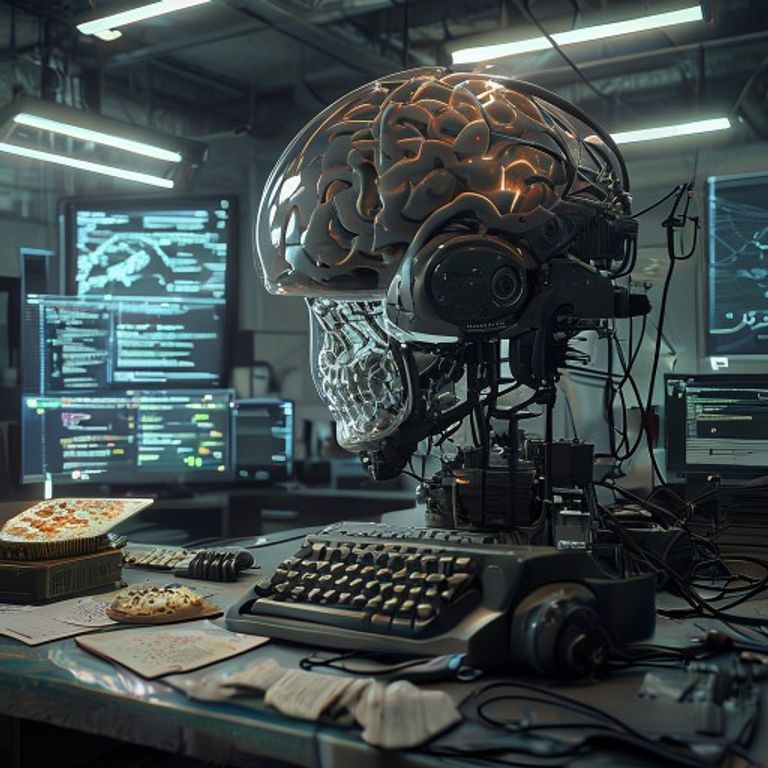
A massive, anachronistic brain-reading helmet with glowing elements sits on a cluttered lab desk, surrounded by vintage typewriters and futuristic holographic keyboards, with screens displaying chaotic brainwave data in a high-tech yet messy laboratory setting, depicting the humorous and unsettling implications of thought-to-text technology.
Typing used to be simple.
A person sat at a keyboard. Fingers pressed buttons. Words appeared on a screen. Sometimes the words made sense. Sometimes they became angry emails written at 2 AM after eating cold pizza. But still, there was a process. A safe little gap between brain and keyboard.
That gap is now in danger.
Because Meta has unveiled Brain2Qwerty v2, an AI system that can turn brain signals into text without needing a brain implant. No surgery. No robot wires poking into the skull. Just a giant helmet that reads brain activity while someone *thinks* about typing.
And suddenly the whole world feels a little less prepared.
The first person who tested it probably sat there wearing the helmet like a confused astronaut while scientists stared at screens full of squiggly lines.
“Think about typing a sentence,” they likely said.
The volunteer probably thought:
*I hope this thing can’t hear my grocery list.*
Meanwhile, the computer slowly typed:
“Need eggs. Also stop breathing so loudly, Kevin.”
That was the moment humanity crossed a line.
The helmet itself sounds very serious. It uses magnetoencephalography, or MEG, which is the kind of word people say when they want everyone else in the room to stop asking questions. The helmet measures tiny magnetic signals from the brain while AI sorts through the chaos and figures out what the person intends to type.
Which is honestly brave.
Because the human brain is not an organized place.
A person can start thinking about an email and suddenly remember a sandwich from 2009. The brain jumps around like a squirrel that drank three cans of soda.
One second:
“Dear team, attached is the quarterly report.”
Next second:
“Did penguins have knees? Wait… do they?”
Now imagine AI trying to decode that mess.
The poor machine is probably exhausted already.
Scientists say the system reconstructs intended keystrokes and creates coherent sentences. Coherent is doing a lot of heavy lifting there. Human thoughts are not coherent. Human thoughts are mostly random panic mixed with snack planning.
A normal brain at 8 AM sounds like this:
*Need coffee. Why is the alarm so loud? Did I reply to that message? Don’t make eye contact with anyone today. Also dinosaurs were huge. That’s crazy.*
If AI can sort through that and produce clean text, it deserves a vacation.
Of course, the system still has limits. Huge limits. Giant, expensive, noisy limits.
The MEG machine is enormous. It sits in a lab and costs more money than several houses combined. It also needs highly controlled conditions. So nobody is casually wearing this thing at a coffee shop yet.
That would be terrifying anyway.
Imagine sitting in a café. A man walks in wearing a giant brain-reading helmet the size of a washing machine. He quietly orders a muffin while sparks and wires hum around his head.
Everyone else slowly leaves.
Even the muffin looks nervous.
The scientists say this technology will not replace keyboards anytime soon. Which is comforting. Humanity is not emotionally ready for thought-typing.
People can barely survive autocorrect now.
Autocorrect already ruins lives daily. Someone tries to type “See you soon” and accidentally sends “Seize your spoon.” Entire friendships have suffered.
Now imagine a device connected directly to the brain.
A boss asks:
“Did you finish the report?”
The employee thinks:
*I would rather live inside a cave.*
And suddenly the AI sends it.
No delete button. No escape. Just instant career damage.
This is why regular typing has always been useful. Fingers give people time to lie politely.
Typing creates a safety buffer between thought and reality.
Without that pause, civilization collapses by lunchtime.
Family dinners alone would become impossible.
Aunt Linda says:
“So when are you getting married?”
And before anyone can stop it, the helmet types:
“Never if your potato salad keeps existing.”
Silence.
Forks freeze in midair.
Somewhere a dog quietly leaves the room.
The biggest problem is that human brains are deeply strange places. People do not think in clean sentences. Thoughts crash into each other like shopping carts in a parking lot.
A person trying to focus on work might suddenly remember an embarrassing moment from fifth grade and physically cringe at the wall.
The AI would probably type:
“Need spreadsheet finished before Friday. Also why did he bark during the school play in 2008.”
Nobody needs that level of honesty.
Still, the technology itself is amazing. It really is. Scientists are basically teaching computers to understand signals from the brain without cutting open someone’s head. Twenty years ago this would’ve sounded like a movie where robots eventually steal Earth’s internet passwords.
Now it’s happening in real life.
And naturally, humans immediately started imagining weird uses for it.
Somebody out there already wants to use it while gaming.
A teenager is probably saying:
“What if I could think faster than I type?”
Meanwhile his mother is saying:
“What if you cleaned your room first?”
Nobody listens to her because the teenager is busy mentally yelling at dragons in a video game.
Office meetings could also
The meeting could’ve been an email, but the email wouldn’t have wasted an hour of everyone’s life.
Now imagine everyone in the meeting wearing thought-typing helmets.
The manager says:
“Any questions?”
The room stays silent.
But the screen suddenly fills with messages:
“Please stop using the word synergy.”
“Carl is asleep.”
“Who ate my yogurt?”
“Fire drill maybe?”
Human Resources would burst into tears.
Dating apps would become even worse somehow.
People already lie on dating profiles constantly.
“Loves adventure” usually means they once parked far away from the grocery store entrance.
But brain typing would reveal the truth immediately.
A dating profile might say:
“Very calm and mature.”
Meanwhile the actual thoughts are:
*Hope this restaurant has chicken nuggets.*
One awkward dinner later, the AI has exposed everything.
Grandma joined social media and now thinks LOL stands for “Lots of Love.” She’s been sending it to everyone at funerals.
Now imagine Grandma with a brain-typing helmet.
Nobody survives that Thanksgiving.
The funny thing is that humans spent years trying to improve keyboards. Mechanical keyboards. Wireless keyboards. Foldable keyboards. Tiny keyboards. Glowing keyboards that sound like tap-dancing raccoons at midnight.
And now scientists looked at all that and said:
“What if we skipped the fingers entirely?”
Somewhere a keyboard company executive is sweating into a necktie.
But there’s still something comforting about normal typing. The clacking sound. The mistakes. The dramatic backspacing after writing something ridiculous.
Thought-typing removes the drama.
A person can no longer aggressively slam the keyboard after losing an argument online. That tiny emotional workout disappears.
Humanity needs that.
Without keyboards, where will frustrated people channel their rage? Exercise? Healthy communication? Absolutely not.
Also, brains are rude.
Very rude.
People pretend they are thoughtful and kind, but internally everyone is one small inconvenience away from becoming a tiny goblin.
A person smiles politely while talking, but the brain quietly whispers:
*Why are you chewing so loudly?*
Brain2Qwerty could accidentally expose humanity’s entire fake-polite system in one afternoon.
Restaurants would collapse first.
Servers would walk up to tables.
Customers would smile warmly.
The helmets would immediately type:
“Please don’t let this burger cost twenty dollars again.”
Then the server’s helmet replies:
“I already know it will.”
Everybody cries softly into the fries.
Of course, there are important medical reasons for this technology too. That part matters. Systems like this could someday help people who cannot speak or move communicate more easily. That’s huge. That’s genuinely wonderful.
But humans are also humans.
So alongside important medical breakthroughs, somebody will absolutely try using it to post faster arguments online about pineapple pizza.
That is inevitable.
The internet always finds a way to turn miracles into nonsense.
Scientists spend years decoding brain activity with advanced AI systems.
Within six months, somebody uses it to mentally type:
“First.”
That’s the species right there.
Even the helmet sounds dramatic. People keep calling it non-invasive, which is a very comforting scientific phrase meaning:
“Good news. Nobody drilled into your skull today.”
That alone already puts it ahead of many inventions.
Meanwhile companies like Neuralink are exploring implanted brain chips, which sounds slightly more intense. That feels like the difference between borrowing a library book and becoming part robot.
Some people are excited about implants.
Others hear “brain chip” and immediately picture ads appearing inside their dreams.
Imagine trying to sleep while a voice whispers:
“Hungry? Try spicy noodles.”
No thank you.
The non-invasive helmet feels gentler somehow. Still weird. But gentler.
Like getting life advice from a microwave.
The biggest challenge for this technology may not even be the science. It may be convincing ordinary people to trust a machine near their thoughts.
People barely trust printers.
Printers have spent decades acting possessed. They jam paper for emotional reasons. They detect low ink even when the cartridge was replaced five minutes ago. A printer will stare directly into a person’s soul and refuse to print a boarding pass out of spite.
And now technology companies want access to brain signals?
Humanity will need several naps before agreeing to that.
Security questions will become strange too.
“What’s your password?”
“Please stop reading my brain.”
Imagine forgetting passwords entirely because the computer recognizes thoughts instead.
Then one stressful day the brain accidentally thinks about an old crush, three grocery items, and a cartoon theme song while logging in.
The laptop explodes.
Honestly, maybe keyboards are fine.
Still, there’s something oddly exciting about all this. Humans keep inventing ridiculous things because curiosity refuses to sit quietly. Somebody saw brain signals and thought:
“What if thoughts could text people?”
That’s both brilliant and slightly alarming.
Like giving raccoons access to online banking.
The future is arriving in weird little pieces. Self-driving cars. Robot assistants. Smart refrigerators that judge people for eating cake at midnight. And now helmets that can turn thoughts into sentences.
Meanwhile most people still cannot remember where they left their charger.
Human progress is uneven.
Very uneven.
One day, maybe far in the future, people really will type using only thoughts. Children may laugh when they see old keyboards in museums.
“Wait,” they’ll say. “People used their hands for this?”
Old people will nod slowly while eating soup.
“Yes,” they’ll whisper. “And we liked it that way.”
Then somebody’s brain helmet will accidentally type:
*This soup tastes like wet paper.*
And the future will continue exactly as expected.



